
Most people notice a commercial ceiling only when it looks stained, sagging, or outdated. That is a mistake, because the ceiling overhead is rarely just a cosmetic finish. In offices, schools, clinics, retail stores, hospitality spaces, and restaurants, commercial ceilings support acoustics, light distribution, maintenance access, and parts of a building’s fire and smoke performance.
That is why the best conversations about commercial ceilings are not really about appearance alone. They are about lifecycle cost, indoor conditions, code-sensitive materials, and whether restoration can preserve performance without the price and disruption of full replacement.

Why commercial ceilings are engineered building systems
A suspended acoustical ceiling is a working building system. The tile, the grid, the plenum space above, and the access points for HVAC, electrical, plumbing, and fire protection all function together. When any part of that system ages poorly, the room below often feels worse long before anyone identifies the ceiling as the cause.
Acoustical tiles are made to do something very specific: absorb reverberant sound. OSHA notes that sound-absorbing materials on walls and ceilings help reduce reverberant sound buildup in hard-surface spaces, though they do not reduce direct line-of-sight noise from the source itself. That distinction matters. A conference room with poor ceiling absorption can feel loud, tiring, and unfocused even when the room looks perfectly normal.
Commercial ceilings also affect brightness and energy use. High light reflectance can help spread natural and artificial light deeper across a room, which can reduce the need for additional fixtures or higher output. Fire performance is another part of the picture. Many suspended ceiling products are selected as part of tested assemblies, so surface changes and field-applied coatings should never be treated casually.
Acoustics: open pores and fiber structure absorb reverberant sound
Lighting: reflective surfaces help distribute light more efficiently
Fire performance: tested materials may support flame-spread and smoke requirements
Utility access
Visual cleanliness
How commercial ceiling tiles affect acoustics, light, and code performance
EPA facility guidance has long treated acoustical ceilings as standard sound-control materials in occupied buildings, especially schools and offices. It also gives useful benchmarks. In many spaces, a ceiling Noise Reduction Coefficient, or NRC, of 0.60 may be acceptable, while open offices and conference areas often benefit from higher values. That means the ceiling is not just there to hide ductwork. It is part of how the room performs.
Aging tiles can lose more than appearance. Dust loading, discoloration, moisture events, repeated handling, and unsuitable coatings can all reduce value. When that happens, owners may see the symptoms first as noise complaints, dimmer interiors, or growing maintenance costs.
A ceiling that performs well can make a room feel calmer, brighter, and more professional without drawing attention to itself.
Sound absorption
Ceiling tiles help reduce echo and speech buildup. Over time, clogged pores or a hardened surface can reduce their sound absorption performance.
Light reflectance
A reflective ceiling helps distribute light and brighten a room. Staining and darkening can reduce reflectivity.
Fire and smoke performance
Ceiling materials can contribute to the performance of tested building assemblies. Unapproved coatings may affect their fire or smoke ratings.
Access above the ceiling
Removable tiles make repairs and inspections easier. Paint or damage can cause tiles to stick to the grid.
Room appearance
A clean, consistent ceiling supports a well-maintained impression. Checkerboard staining can make a space look neglected.
Why dirty commercial ceilings can hurt indoor air quality
Commercial ceiling tiles spend years collecting what the room and the HVAC system send upward. That often includes dust, smoke residue, grease, cooking vapors, moisture, and fine airborne particles. In some settings, microbial growth can also become part of the problem when conditions allow it.
This is one reason ceiling conditions matter in healthcare, education, food service, and busy offices. EPA guidance for schools notes how common acoustical ceiling systems are, and it also advises caution before painting or coating acoustical materials. That caution exists for a reason: the ceiling surface interacts with air movement, maintenance, and long-term room conditions.
Facility teams usually clean floors, countertops, glass, and touchpoints on a routine cycle. The ceiling, by contrast, can go untouched for years. When the overhead surface is visibly stained, the room feels less clean even if every other surface has been serviced.
That mismatch leaves one of the largest visible surfaces in the building outside the cleaning plan.
Why painting acoustic ceiling tiles can damage acoustic performance
When stains become obvious, standard paint can look like the fastest fix. It is rarely the smartest one. Ordinary latex paint creates a film across the tile surface, and that film can block the very pores that allow an acoustical panel to absorb sound. A cleaner look may come at the cost of a noisier room.
Painting can create other problems as well. EPA guidance advises consulting the manufacturer before painting acoustical material, and that is sound advice for any facility manager. Field-applied paint may change surface behavior, affect maintenance access, and complicate compliance questions tied to rated products or assemblies.
Lower NRC
Tiles bonded to the grid
Maintenance access: stuck tiles slow HVAC, plumbing, and electrical work
Code questions: unapproved coatings can create uncertainty around tested performance
Shorter useful life
Seeing the difference between cosmetic paint and acoustically compatible restoration coatings is one of the biggest turning points in ceiling planning.
Commercial ceiling restoration vs replacement costs and downtime
For many buildings, the real decision is not whether the ceiling matters. It is whether the right path is replacement or restoration.
Replacement is sometimes necessary. Broken tiles, severe water damage, mold-related material failure, repeated plenum contamination, or major redesign work may call for full removal. Yet many ceilings that look poor are still structurally serviceable. In those cases, restoration can be the more strategic choice.
Specialty restoration programs usually combine deep cleaning or sanitizing with an acoustical coating designed to preserve porosity rather than fill it. This matters because the goal is not simply to turn a stained ceiling white again. The goal is to keep the ceiling functioning as an acoustical surface while improving appearance, maintaining access, and limiting disruption to the business below.
Contractors in this category often position restoration as dramatically less expensive than replacement, sometimes by margins that approach 80 percent in the right conditions. Exact savings depend on the tile type, the amount of staining, access requirements, working hours, and whether the metal grid also needs attention. Still, the cost gap can be significant, especially when replacement would require demolition, disposal, new material, and business interruption.
Standard paint
Upfront cost: Low at first
Downtime impact: Low to moderate
Acoustic risk: High
Best fit: Very limited use for cosmetic purposes only
Full replacement
Upfront cost: Highest
Downtime impact: Often highest
Acoustic risk: Low when the replacement system is specified well
Best fit: Failed or broken ceilings, or projects that require a redesign
Professional restoration
Upfront cost: Moderate to low
Downtime impact: Often low
Acoustic risk: Low when the system is designed for acoustical tile
Best fit: Stained or aged ceilings that are still serviceable
Another benefit is scheduling. Restoration work can often be performed after hours or in contained zones, which helps facilities stay open. That matters for revenue-generating spaces, patient-facing operations, schools, and workplaces where closing rooms has a real cost.
Which commercial buildings benefit most from commercial ceiling restoration
The strongest fit is usually any building with a large suspended acoustical ceiling, recurring overhead staining, and a need to stay operational during the work.
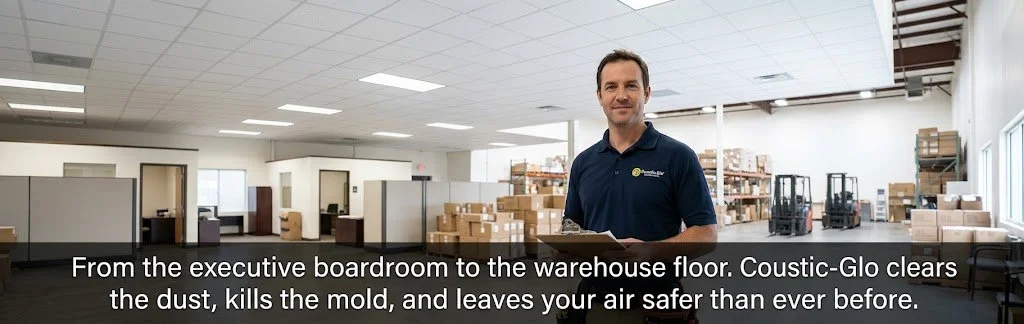
Offices, call centers, schools, medical and dental clinics, hospitality spaces, retail stores, and restaurants often fall into that category. The same is true for buildings with long corridors, conference rooms, or hard-surface interiors where ceiling acoustics shape the daily experience of the space.
Offices and call centers
Schools and training rooms
Medical and dental clinics
Retail stores and hotel corridors
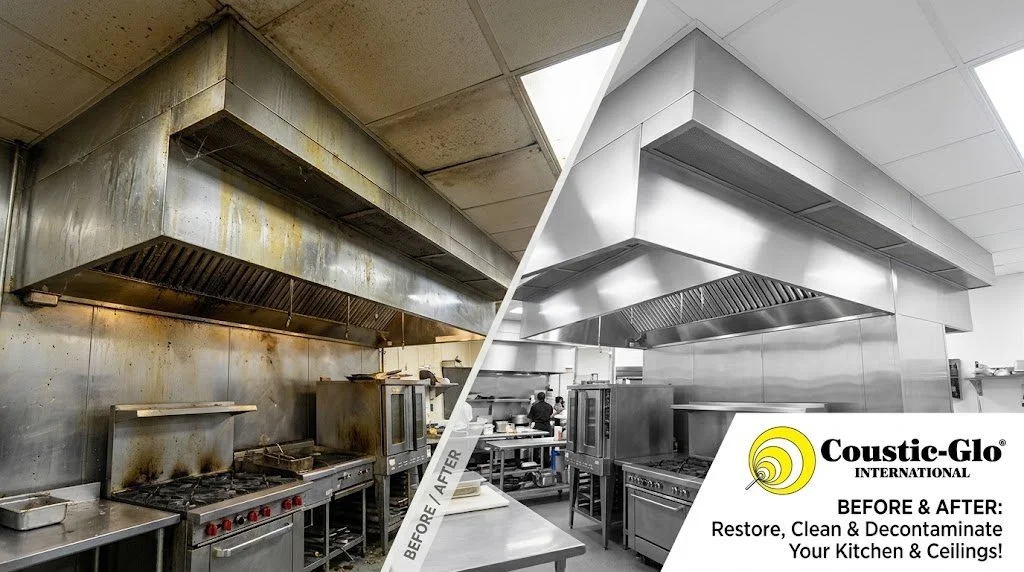
Restaurants and commercial kitchens
Sustainable commercial ceiling maintenance and LEED opportunities
Ceiling replacement creates waste fast. Large amounts of mineral fiber tile, packaging, and metal components can leave a building in a short period, even when much of the system is still physically usable. Restoration changes that equation by keeping more material in service.
That fits well with sustainability goals. EPA purchasing guidance has also highlighted recycled content in acoustical ceiling tile, reinforcing the broader value of material efficiency. Extending the life of an existing ceiling can support waste reduction goals, reduce hauling and disposal, and limit the demand for new material production.
For teams tracking LEED or internal ESG goals, ceiling restoration may support better outcomes in categories tied to materials, waste diversion, and indoor environmental quality. A ceiling is rarely the whole sustainability story, though it can become an easy win when the alternative is demolition.
Internal link ideas for commercial ceiling SEO
If the goal is stronger rankings for companies offering this work, the article should sit inside a focused content cluster rather than standing alone. A service page, a cost page, an acoustics page, and industry-specific pages can all support the main keyword while meeting different search intent.
Commercial ceiling restoration: link to the main service page with process details, coating types, and project fit
Acoustic ceiling tile cleaning: link to a page about smoke, dust, grease, and nicotine staining
Ceiling grid restoration: link to content on rusted grid covers, staining, and when replacement is needed
Ceiling replacement vs restoration: link to a cost comparison page with lifecycle examples
Ceiling fire rating and NRC guide: link to an educational article explaining sound absorption and code-sensitive materials
A strong internal structure should also include pages by market segment. Commercial kitchen ceiling restoration, school ceiling tile restoration, office acoustic ceiling cleaning, medical office ceiling sanitation, and hotel corridor ceiling renewal all match real buyer searches. Add before-and-after galleries, FAQs, and short pages about downtime, odor, drying time, and safety documentation, and the site becomes much more useful for both users and search engines.
Commercial ceilings reward a more technical, more practical view. When owners and facility managers stop treating the ceiling as a blank white surface and start treating it as an asset, better decisions usually follow. That can mean replacement when the system has failed. In many other cases, it means protecting acoustics, appearance, and budget with a restoration plan built for the material that is already in place.