The Hidden Ceiling Tax: How Commercial Facilities are Wasting Billions (And the Lucrative Franchise Solving It)
Look up in almost any commercial building and you will usually find the same thing: acoustical ceiling tile. Restaurants, medical offices, schools, retail stores, call centers, and corporate suites all rely on drop ceilings because they are practical, affordable, and functional.
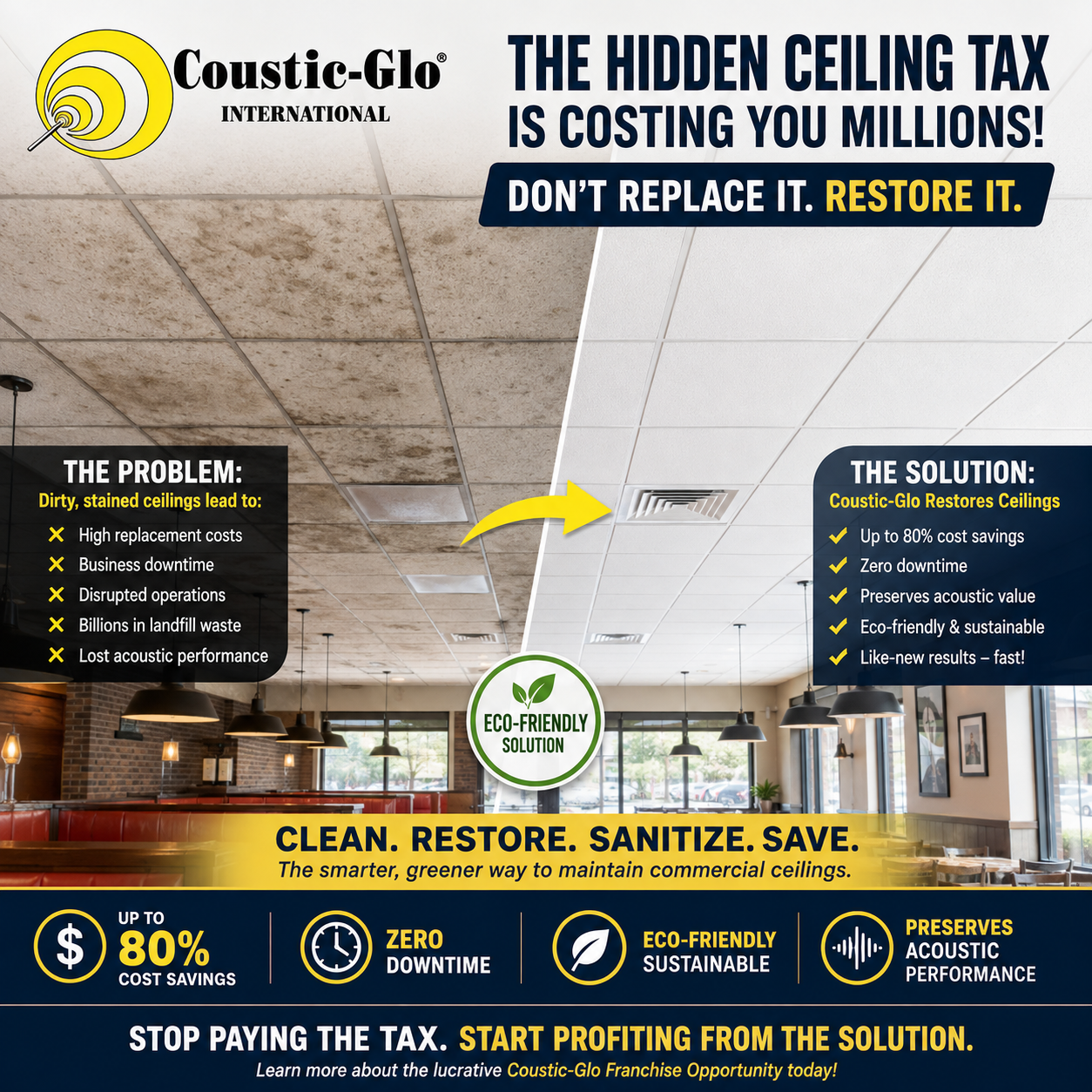
Yet one of the most common assumptions in facility management is also one of the most expensive. When ceiling tiles begin to look old, stained, dusty, or yellowed, many operators assume replacement is the only responsible option. That assumption creates what can fairly be called a hidden ceiling tax: a recurring expense that drains budgets, disrupts operations, and sends usable materials straight to the landfill.
Hidden ceiling tax in commercial facilities
The cost is easy to miss because it rarely appears as a single line item. A stained ceiling does not just trigger the purchase of new tile. It often sets off demolition, labor scheduling, waste hauling, after-hours coordination, and tenant complaints. In occupied buildings, the ceiling becomes a surprisingly expensive surface to “fix.”
This matters because acoustical ceilings are everywhere. In many sectors, they span thousands of square feet per property. Once a portfolio includes dozens or hundreds of sites, the accumulated cost of replacement becomes very real.
Aging ceilings typically show up in familiar ways:
Water stains
Grease film
Dust buildup
Sagging tiles
Smoke discoloration
Surface damage around vents and lights
None of those symptoms automatically means the ceiling has failed structurally or acoustically. Very often, the issue is visual condition, not core function.
Why ceiling replacement costs more than most budgets expect
Replacement is often treated as routine maintenance, but the true bill is much broader. New tile is only one part of the spend. Labor can be heavy, access can be awkward, and the work often affects the daily use of the space.
A facility manager may also face a timing problem. Ceiling work in a clinic, restaurant, or retail store cannot always happen during normal business hours. If the site must close, cordon off sections, or work around customers, the project gets harder and more expensive.
The difference becomes clearer when the options are compared side by side.
Cost Comparison: Full Ceiling Replacement vs. Ceiling Restoration
Materials
Full Ceiling Replacement: Requires new tiles and sometimes new grid components.
Ceiling Restoration in Place: Uses specialized cleaning and restoration materials.
Labor
Full Ceiling Replacement: Involves demolition, removal of old materials, and installation of new components.
Ceiling Restoration in Place: Focuses on surface treatment and touch-up work.
Downtime
Full Ceiling Replacement: Often results in significant business downtime.
Ceiling Restoration in Place: Typically limited downtime, with work often performed after hours.
Waste
Full Ceiling Replacement: Generates a high volume of waste.
Ceiling Restoration in Place: Produces much less waste.
Acoustic Performance
Full Ceiling Replacement: Acoustic properties may change depending on the new product used.
Ceiling Restoration in Place: Acoustic performance is often preserved when properly treated.
Project Speed
Full Ceiling Replacement: Projects tend to move slower, especially in occupied spaces.
Ceiling Restoration in Place: Restoration is usually faster and less disruptive.
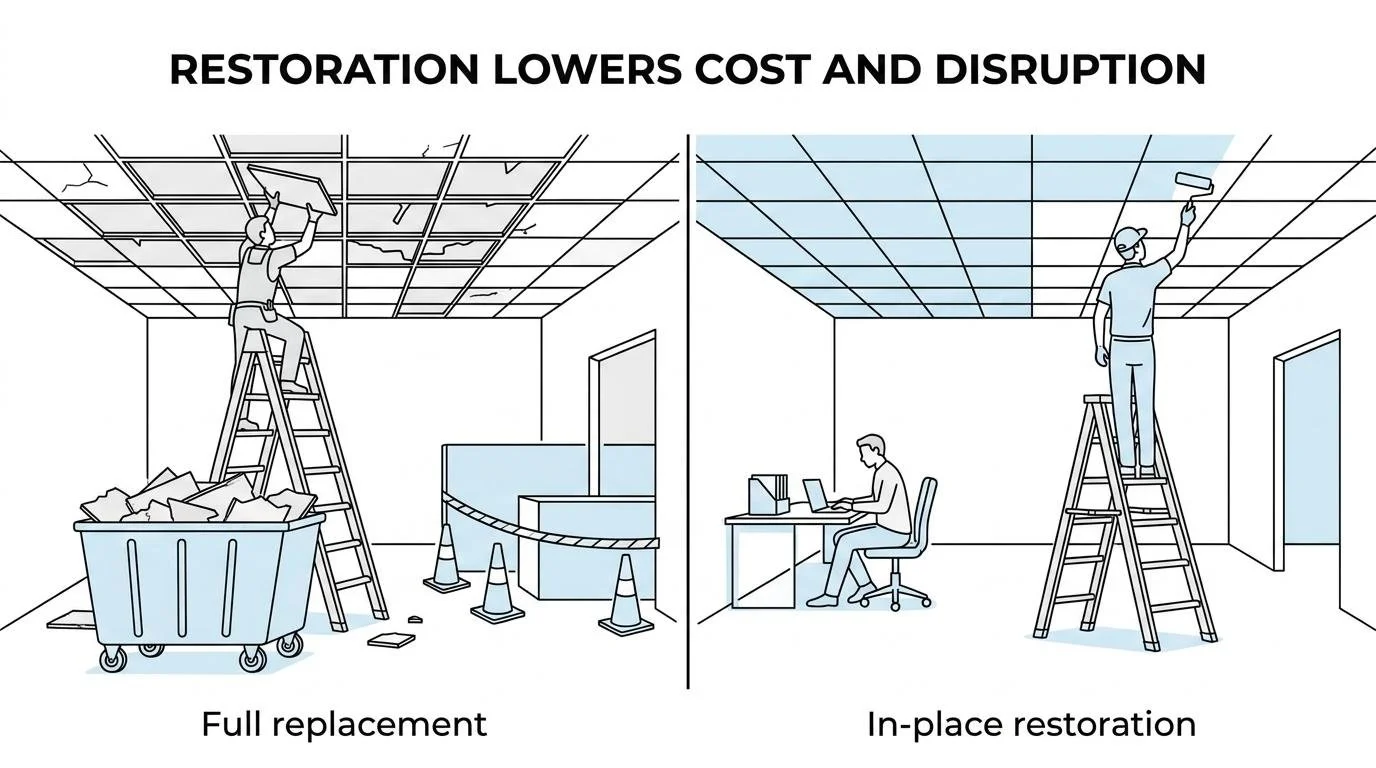
That gap is not just anecdotal. Buildings reported that in many situations, ceiling restoration is about half the dollar cost of replacement and can be completed in occupied spaces in about one-third of the time. The same source also notes reduced solid waste and potential gains in light reflectance, which can support lower energy use.
Side-by-side comparison of full ceiling replacement and in-place ceiling restoration across cost, labor, downtime, waste, acoustic performance, and project speed.
Those are meaningful savings, especially at scale.
Downtime, acoustics, and waste are part of the real price
When budgets focus only on the invoice from a ceiling contractor, several hidden costs stay off the page. That is where poor decisions tend to start.
A restaurant that closes even briefly can lose more than material cost. A medical office may need to reschedule patients. A retailer may lose foot traffic at the wrong time of year. In portfolio management, a disruption at one site is annoying. A disruption across fifty sites becomes a serious operational problem.
Then there is the acoustic issue. Some owners try to “refresh” old ceiling tiles with ordinary paint. That can make the ceiling look cleaner for a while, but it often fills the porous surface that helps absorb sound. The room may look brighter and perform worse. In offices, dining rooms, and waiting areas, that tradeoff can be costly in a different way.
Highlighted quote reading, 'The room may look brighter and perform worse.'

The waste side is hard to ignore as well. EPA reporting has shown that construction and demolition debris in the United States reached hundreds of millions of tons in a single year. Ceiling systems are only one slice of that total, but they are part of a much larger pattern: functional building materials being removed because replacement feels familiar.
Several issues sit behind that hidden tax:
Business interruption: lost sales, rescheduled appointments, tenant frustration
Material waste: usable tiles discarded during cosmetic refresh cycles
Acoustic loss: paint or poor replacement choices can reduce sound absorption
Labor intensity: demolition and installation add time and complexity
For organizations with sustainability commitments, that pattern can also work against internal ESG goals. Throwing away reusable material is difficult to justify when restoration is a viable option.
Why commercial ceiling restoration changes the economics
Restoration changes the conversation from replacement by default to replacement only when necessary.
That distinction matters. If a ceiling has severe structural damage, contamination that cannot be remediated, or hazardous material concerns, removal may still be the right answer. Older buildings also require caution, especially where legacy materials may be present and regulated handling is required. But many commercial ceilings are not in that category. They are simply dirty, stained, or cosmetically tired.
When restoration is done properly, the value case is strong:
Lower direct cost
Faster project completion
Less disruption in occupied spaces
Reduced landfill impact
It also fits the way commercial operators prefer to buy. Facility leaders do not usually want a dramatic capital project when a targeted maintenance solution will restore appearance and function. If the ceiling can look close to new, keep its performance, and avoid closure time, the decision becomes much easier.
This is one reason the category remains attractive. It solves a clear problem that many buyers already have, yet it still carries a low level of public attention compared with roofing, flooring, or HVAC work.
How Coustic-Glo approaches commercial ceiling restoration
Coustic-Glo specializes in restoring commercial ceilings rather than replacing them unnecessarily. According to the company, its work includes cleaning, repairing, sanitizing, and recoating acoustical ceilings and walls across commercial, industrial, and residential properties, with the commercial segment standing out as a major fit for the service model.
The appeal is straightforward. Instead of tearing out stained or discolored tiles, technicians restore them in place using specialized methods and proprietary solutions. That can allow a business to keep operating while the visual condition of the ceiling improves dramatically.
Coustic-Glo presents a few core advantages in this space:
Cost savings: the company says clients can save up to 80% compared with replacement
Operational flexibility: work is often suited to after-hours scheduling
Performance preservation: restoration is designed to maintain acoustic and fire-related properties rather than clog the tile like ordinary paint
Environmental benefit: fewer materials are hauled away and discarded
For franchise prospects, the company outlines its model here: Coustic-Glo franchise information.
The reason this positioning matters is simple. Commercial buyers are not asking for novelty. They are asking for a faster, cheaper, lower-disruption answer to an old facilities problem. Restoration gives them that answer.
Why the franchise opportunity stands out in B2B services
From an ownership standpoint, ceiling restoration has several qualities that tend to make B2B service models attractive.
First, it is mobile. The work happens at the client site, so there is no need for a customer-facing storefront. That can keep overhead lighter than many franchise categories. Second, any property with drop ceilings can become a prospect, whether it is a school, office, restaurant chain, healthcare facility, municipal building, or retail location.
Third, the service addresses a recurring need. Ceiling systems age gradually. Facilities change hands. Renovation budgets tighten. Brand standards still need to be maintained. That creates repeat demand and a practical opening for relationship-based selling.
This does not mean every market behaves the same way, and it does not remove the need for local sales skill. B2B service businesses still depend on territory development, estimating discipline, operational consistency, and credibility with facility decision-makers. Yet the category has several appealing traits:
Large addressable market
Visible before-and-after results
Lower waste than replacement
A clear cost-savings story for buyers
The margin discussion often attracts attention too. In promotional materials and franchise conversations, restoration businesses are often described as lean operations because they rely more on process, chemistry, labor skill, and scheduling than on heavy equipment or expensive inventory. That can support strong unit economics when contracts are priced and executed well. Prospective owners should still review the franchisor’s disclosure documents, speak with current operators, and examine market demand in their area before making decisions.
What facility managers should evaluate before replacing a ceiling
A better ceiling decision starts with a better diagnosis.
Not every ceiling should be restored, and not every ceiling should be replaced, making it crucial to evaluate the restore vs replace options carefully. The right call depends on contamination, damage, code requirements, building age, and occupant needs. Still, too many projects move straight to removal before anyone asks whether the tile is actually beyond recovery.
A disciplined review can help:
Condition: Is the problem cosmetic, structural, or environmental?
Downtime risk: What revenue or service disruption will occur during replacement?
Performance: Will the chosen method preserve acoustic and fire-related properties?
Waste impact: How much material will be removed and where will it go?
This is also where outside references matter. The Buildings article on extending ceiling life remains useful because it frames restoration as a building-operations decision, not just a cosmetic one.
In practical terms, the strongest projects are often the least dramatic. A ceiling that looks worn can be brought back into acceptable condition quickly, with less mess, less waste, and less business interruption than most managers expect. Once that becomes visible, the hidden ceiling tax stops looking like an unavoidable cost of ownership and starts looking like a fixable habit.
For facility teams, that can protect budgets. For entrepreneurs, it can open a durable niche. And for commercial spaces that need to look clean, bright, and professional every day, it turns a neglected overhead surface into a measurable business opportunity.
Contact Coustic Glo
Ready to eliminate the hidden ceiling tax and transform your facility’s overhead—literally and financially? Whether you’re a facility manager seeking sustainable savings or an entrepreneur looking for a high-margin, future-proof business, Coustic-Glo is your partner in smarter ceiling solutions. Don’t let outdated practices drain your budget or the environment. Take the first step toward a cleaner, greener, and more profitable future.
Contact Coustic-Glo today to schedule a free consultation or learn more about franchise opportunities. Discover how you can restore, not replace—and turn every ceiling into a competitive advantage.