
If your acoustical ceiling tiles are stained, yellowed or gray with HVAC soot but still dry, flat and intact, restoration beats replacement, and painting is never the answer. Professional ceiling restoration cleans and resurfaces tiles in place. It keeps their sound absorption and fire performance, leaves them removable, and costs up to 80% less than a full tear-out.
When drop ceilings in an office, restaurant, school or medical facility turn yellow, water-stained or covered in HVAC soot, a roller and a bucket of latex paint look like a quick, cheap fix. In reality, painting acoustical ceiling tiles is one of the most expensive mistakes a building owner or facility manager can make.
Standard paint destroys the very properties acoustic ceilings are engineered to provide, and it often forces you to pay for a full ceiling replacement anyway. At Coustic-Glo, we've been restoring commercial ceilings since 1975. Below is exactly how we help facility managers decide between restoring, replacing and painting, and why restoration wins for most stained ceilings.
Restore, replace or paint? The quick answer
Restore when tiles are stained, discolored, or filmed with smoke, grease or soot, but are still dry, flat and structurally sound.
Replace when tiles sag, crumble, break, show mold, or are still getting wet from an active leak.
Never paint acoustical ceiling tiles with standard paint. It trades a short-term cosmetic fix for lost acoustics, voided warranties and a ceiling you'll end up replacing.
What causes stained ceiling tiles?
Most stained ceilings we inspect share a handful of causes:
Water stains from roof, plumbing or HVAC condensation leaks. Fix the source first, or the stain comes back.
Yellowing from age, light exposure and, in older buildings, years of nicotine.
HVAC soot, the dark halos that form around supply diffusers as air pushes dust into the tile.
Grease and smoke residue in and near commercial kitchens.
Every one of these sits on the surface or in the top layer of the tile. That's why most can be cleaned and resurfaced instead of thrown away.
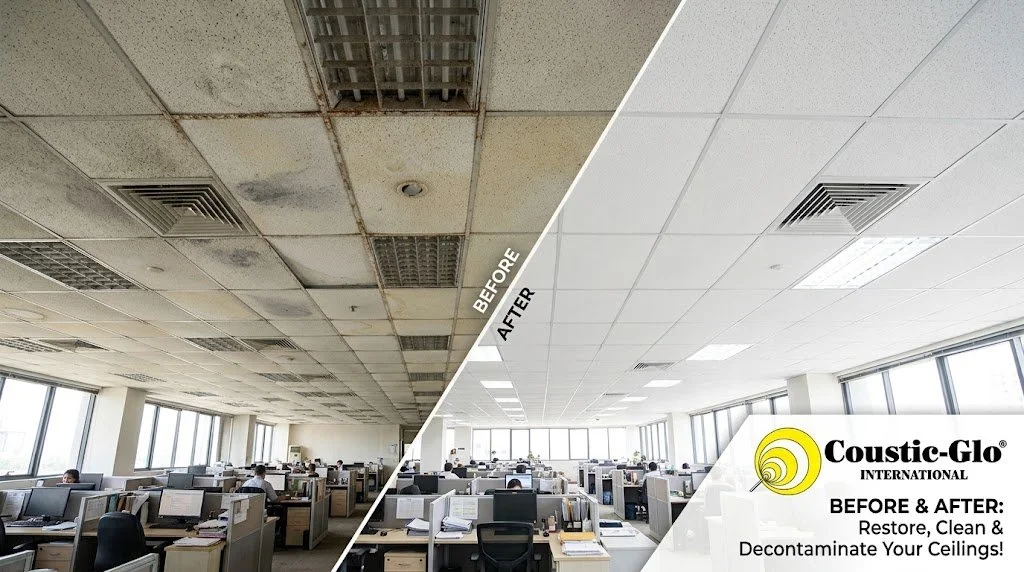
HVAC soot, water stains and a rusted grid in an open-plan office, next to a bright, even ceiling after restoration. Restoring costs up to 80% less than replacing the tiles.
5 reasons painting acoustic ceiling tiles backfires
Acoustic ceiling tiles are built with microscopic pores that trap sound waves, and they're manufactured to meet strict commercial safety codes. Conventional paint creates five immediate problems.
1. It ruins sound absorption
A tile's sound absorption is measured as its Noise Reduction Coefficient (NRC), averaged from lab readings taken under the ASTM C423 test. The scale runs from 0.00, a surface that reflects almost all sound, to 1.00 and slightly above; the WELL Building Standard calls for NRC 0.9 or higher across open-office ceilings. Latex and oil-based paints seal over the porous surface. Instead of absorbing noise, the ceiling starts reflecting it, turning quiet offices, clinics and dining rooms into loud, echoing spaces.
Ceiling manufacturers' own maintenance guides warn that field painting changes a tile's acoustical performance.
2. It voids your fire performance guarantees
Most commercial acoustical tiles carry a Class A interior-finish rating: a flame spread index of 0–25 and a smoke-developed index of 450 or less in the ASTM E84 tunnel test. Minnesota's State Fire Marshal explains how these flame-spread classes differ from the fire-resistance ratings of whole floor and ceiling assemblies. Once a tile is field-painted, leading ceiling manufacturers say they can no longer guarantee its flame-spread and smoke ratings, and painting voids the warranty.
That matters the day a fire marshal, insurer or inspector asks you to document your ceiling's rating. "We painted it ourselves" is not documentation.
3. It glues tiles to the metal grid
Paint seeps into the edges where tiles rest on the T-bar grid and bonds them together. The next time a technician needs to reach plumbing, wiring, sprinklers or HVAC ducts above the ceiling, tiles crack and break when lifted.
4. It makes tiles sag and dulls the room
The same manufacturer guidance says painting can change a tile's dimensional stability and light reflectance. A wet coat adds moisture and weight to a fiber panel. Over time painted tiles can bow between grid members, and a duller surface bounces less light back into the room.
5. It traps dirt, odors and bacteria
Painting over stained tiles doesn't clean them. It seals years of grease, smoke residue, mold spores and allergens underneath, and many water stains bleed right back through the new coat.
We cover the indoor air quality side in more depth in The Forgotten Hazard Above Your Head: Why Cleaning Your Ceiling Matters Way More Than Painting It.
Why full replacement isn't the default answer either
Replacing an entire suspended ceiling system is messy, disruptive and expensive. It often means days of downtime, demolition dust, dumpster fees and a ceiling's worth of mineral fiber headed for a landfill.
It also carries hidden costs. Tile patterns get discontinued. Replacing only the worst tiles leaves a checkerboard of bright new panels beside aged ones. And every hour your space is under construction is an hour employees, patients or customers work around it.
The trade press has tracked this gap for years. Walls & Ceilings reported the industry rule of thumb that restoration costs half or less of new tile replacement and takes about one-third the time, and that restored tiles stay out of landfills.
The Coustic-Glo alternative: restore instead of replace
Our proprietary cleaning and resurfacing process restores stained, aging ceilings to like-new condition for up to 80% less than the cost of replacement. Here's what sets professional restoration apart from a paint job.
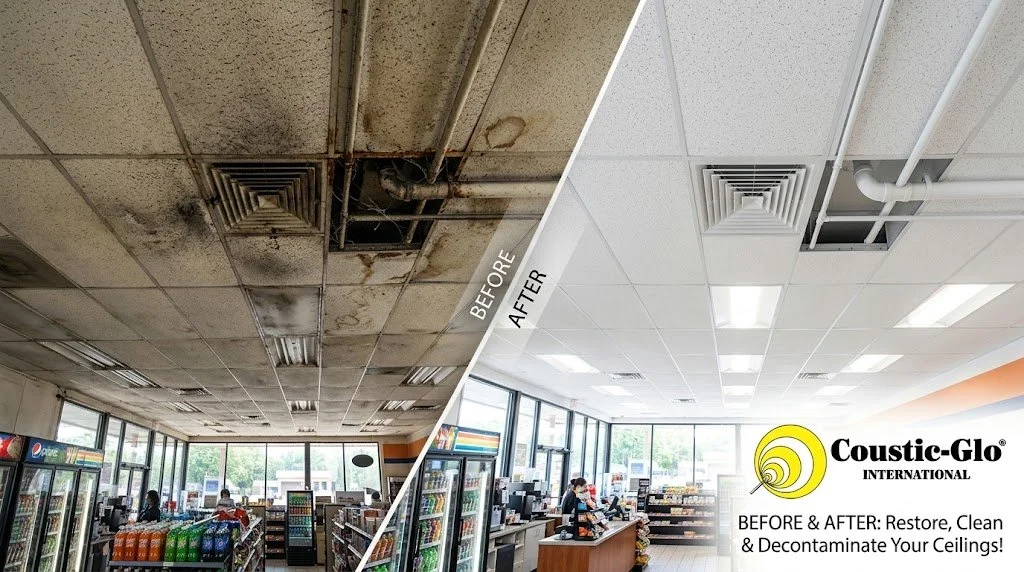
Water stains, soot and yellowing on a retail drop ceiling, next to a clean, uniform ceiling after restoration. No tear-out, no demolition dust.
It preserves acoustic performance
Our Coustic-Coat finish is formulated specifically for acoustical surfaces and applied with airless sprayers, not rollers. It brightens and revitalizes tiles without blocking their fissures and pores, so your sound control stays intact. Independent acoustical engineering test data is available on request.
It restores fire retardance instead of compromising it
Unlike standard paint, Coustic-Coat is a fire-retardant coating. It's listed by the California State Fire Marshal (listing #2280-1245:100) and restores the ceiling's flame and smoke retardation rather than covering it with an untested layer.
It cleans, deodorizes and improves indoor air quality
Before resurfacing, we deep-clean tiles with our patented B+ process. Surfactants and oxidizers lift built-up dust, nicotine, cooking grease and stains and reduce microorganisms. The result is fewer odors and fewer "Sick Building Syndrome" complaints. Independent lab air-quality studies show the active ingredients are no longer present in the space one hour after service.
It restores rusted or yellowed grids
Our Coustic-Grid Geo-Vinyl capping snaps over standard 15/16-inch exposed T-bar, with matching T, cross and L-shaped caps for every junction. Stained or corroded grid looks crisp and new again, without sealing the tiles shut. We clean and coat HVAC vents to match, so the whole ceiling plane reads as one bright surface.
It works around your business, not the other way around
Most commercial projects are scheduled overnight or over a weekend. We enclose the work area in plastic sheeting, spray, then remove the plastic and leave the space as clean as we found it. No demolition, no construction debris, no dumpster in your parking lot.
How our ceiling restoration process works
Depending on your ceiling, a project includes some or all of these steps:
Free on-site inspection and demonstration. We confirm tiles are dry, flat and sound, flag any active leaks, and restore a test area so you see the result first.
Protect the space. Furnishings are covered with drop cloths or tarps, and coating areas are enclosed in plastic sheeting.
Deep clean. Our patented B+ cleaner goes on with a low-pressure sprayer. Grid, speaker covers and vents are detail-cleaned by hand.
Resurface. Coustic-Coat is applied with airless sprayers in your choice of whites or special-order decorator colors.
Cap the grid, if needed. Geo-Vinyl capping snaps over rusted or yellowed T-bar.
Hand it back clean. Plastic comes down, the space is left as clean as we found it, and you're open for business.
Ceiling restoration vs. painting vs. full replacement
Here's how the three options compare on the five things facility managers ask us about most.
Upfront cost
Standard painting: Low at first, high long-term cost once the ceiling has to be replaced anyway.
Full ceiling replacement: Very high: materials, labor and disposal.
Coustic-Glo restoration: Up to 80% less than replacement.
Sound absorption
Standard painting: Ruined. Paint clogs the tile pores.
Full ceiling replacement: Maintained.
Coustic-Glo restoration: Preserved. Our coating doesn't block the pores.
Fire rating
Standard painting: Compromised. Manufacturers won't guarantee fire performance, and the warranty is void.
Full ceiling replacement: Maintained.
Coustic-Glo restoration: Restored with a listed fire-retardant coating.
Access to above-ceiling utilities
Standard painting: Tiles glued to the grid. They crack when lifted.
Full ceiling replacement: Easy access.
Coustic-Glo restoration: Tiles stay free and removable.
Business disruption
Standard painting: Fumes and mess.
Full ceiling replacement: Days of demolition and dust.
Coustic-Glo restoration: Scheduled overnight or on weekends, with no demolition.
When ceiling tile replacement is the right call
Restoration isn't the answer for every ceiling, and we'll tell you so during the inspection. Replace tiles that are:
Sagging or warped between grid members
Crumbling, cracked or broken
Showing mold or mildew
Still getting wet. Fix the leak first, then decide.
Replacement also makes sense when you're changing the layout, the look or the acoustic spec of the room. When only a few tiles are too far gone, we can restore the rest of the ceiling so new and old tiles share one even color, with no checkerboard.
Who we restore ceilings for
We restore ceilings in office buildings, hospitals and clinics, hotels, restaurants, schools and retail stores: anywhere a dingy ceiling hurts first impressions and a tear-out would disrupt the people inside. For more on what facility managers should know, read Commercial Ceilings: 5 Facts Facility Managers Should Know About Acoustics, Fire Ratings, and Cost.
Ceiling restoration in Minneapolis–St. Paul
Coustic-Glo is headquartered in Eden Prairie, Minnesota. We restore ceilings for offices, clinics, restaurants and retailers across Minneapolis, St. Paul and the Twin Cities metro. Long Minnesota heating seasons keep buildings sealed and HVAC systems running hard, pushing dust and soot into the tiles overhead.
Own a Coustic-Glo dealership
We've franchised our process since 1982, with partners across North America and around the world. If you want to build a business around the ceilings every commercial building has, see The Hidden Ceiling Tax or become a dealership.
Frequently asked questions
Can you paint acoustic ceiling tiles?
You can, but you shouldn't. Standard paint seals the pores that absorb sound, can glue tiles to the grid, and voids the manufacturer's warranty. Ceiling manufacturers say they can't guarantee a painted tile's fire, acoustic or sag performance.
Is it cheaper to restore or replace ceiling tiles?
Restoring is cheaper. Coustic-Glo restoration costs up to 80% less than replacement, and trade publications have long put the industry average at half the cost or less. Per the same sources, restoration also takes about one-third of the time, and it avoids disposal fees.
Does ceiling restoration affect the fire rating?
Not when it's done with the right coating. Coustic-Coat is a fire-retardant coating listed by the California State Fire Marshal, and it restores flame and smoke retardation. Ordinary paint is untested on your tiles, which is why manufacturers stop guaranteeing fire performance once tiles are painted.
Will restoration reduce my ceiling's NRC?
Our coating is sprayed on and formulated not to block the tile's fissures and pores, so sound absorption is preserved. Independent acoustical test data is available on request.
Can water-stained ceiling tiles be restored?
Yes, if the tiles are dry, flat and free of mold. Fix the leak first. Tiles that are soft, sagging or moldy should be replaced.
Do we have to close during restoration?
Usually not. Most commercial projects are scheduled overnight or over a weekend, and there's no demolition or debris.
Can you restore the metal grid too?
Yes. Our Geo-Vinyl grid capping snaps over standard 15/16-inch T-bar to cover rust and yellowing.
Give your facility a brighter, cleaner ceiling
You don't have to live with water stains and dingy ceilings, or blow your maintenance budget on a full tear-out. Whether you manage an office building, hospital, hotel, restaurant or retail space, Coustic-Glo delivers dramatic results in a fraction of the time.
Contact your local Coustic-Glo specialist today, or call (952) 835-1338, for a free on-site demonstration and estimate. See how easy it is to make your ceilings look brand new again.